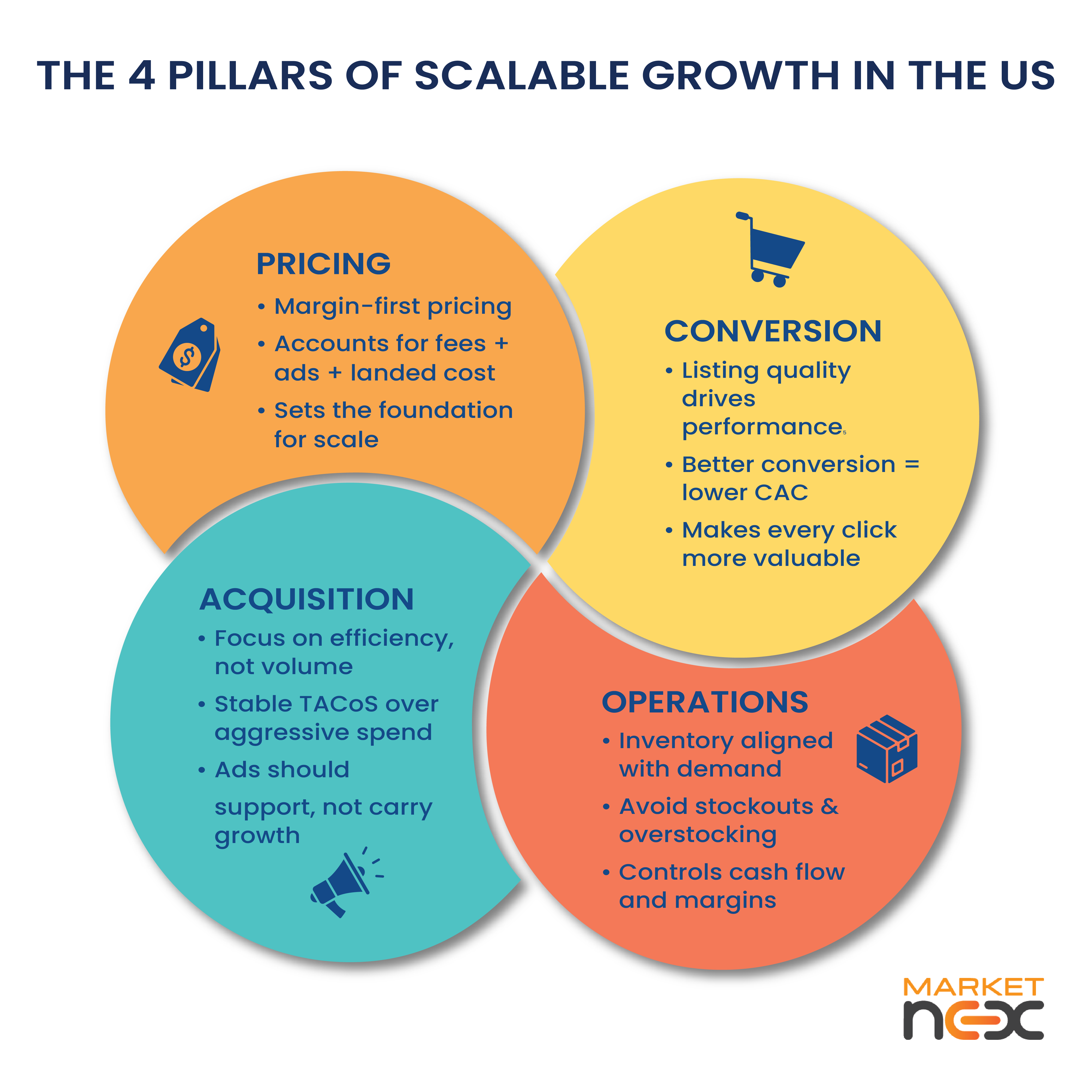
What Most Growing Brands Get Wrong About Marketplace Scaling
Marketplace growth slows down when brands scale traffic before fixing the systems that convert it.
Getting a product to sell on Amazon is no longer the constraint for most brands.
With the right mix of ads, pricing, and positioning, demand can be generated predictably. The real shift happens after that, when the question moves from “Will this sell?” to “Why is growth getting more expensive than it used to be?”
This is where growth starts to get expensive.
Across the Amazon ecosystem, sellers collectively spend billions of dollars annually on advertising, with many mid-to-large brands allocating anywhere between 25- 40% of their revenue to paid acquisition in competitive categories. At the same time, studies have shown that even a 1% drop in conversion rate can significantly impact ranking and sales velocity, especially at scale.
Across brands operating in the ₹50L to ₹5Cr/month range, the pattern is consistent. Revenue continues to grow, but contribution margins stay flat, limiting any meaningful improvement in profitability. As TACoS climbs past the 15-18% range, it becomes increasingly difficult to bring back under control. Sales start leaning more heavily on paid acquisition, and at the same time, catalogue expansion introduces added complexity without delivering a meaningful improvement in output.
At MarketNex, we see this transition repeatedly across scaling accounts. Individually, none of these signals indicate a failure, but collectively, they point to a different problem.
While growth seems to continue, it’s no longer compounding at the same pace.
We refer to this stage as the Scaling Efficiency Gap, where the business has traction, but lacks the structural alignment required to scale profitably.
Most brands don’t identify this shift explicitly. Instead, they continue operating the way they did during early growth, allocating more budget, expanding catalogue, adjusting pricing in response to competition.
This article breaks down where scaling typically starts to break at this stage, how those issues show up in your account, and what needs to change for growth to become efficient again.
Mistake 1: Using paid growth to compensate for weak conversion
At scale, most growth problems are misdiagnosed as traffic problems when they are, in reality, conversion problems.
The default response when growth slows is to increase visibility. Budgets grow, with campaigns broadening and new keyword sets being tested along the way. This creates the appearance of progress because revenue continues to move upward.
However, when we audit accounts where TACoS has crossed 18% in a mature category, the issue is rarely inefficient advertising, it is underperforming conversion relative to the category.
To put this in practical terms, a product converting at 9- 10% in a category where competitors operate at 14- 18% carries an invisible cost. Clicks get harder to justify, so ad spend creeps up just to maintain volume and with organic rankings not keeping pace, profitability starts to shrink.
Across 30+ accounts in the ₹50L- ₹2Cr/month range, listings converting below 11% required 28- 42% higher ad spend to sustain the same revenue levels. TACoS did not stabilize until conversion improved meaningfully.
What makes this particularly dangerous is that it does not feel like a failure. The account continues to generate sales, and the instinct is to scale what appears to be working. In reality, the business becomes dependent on paid acquisition to sustain performance that should have been supported organically.
In over 70% of such cases, reducing ad spend by just 15- 20% led to a 30- 40% drop in sales, exposing this dependency.
The fix at this stage:
- Reworking the listing based on how competitors are winning conversion instead of operating purely off internal assumptions.
- Aligning copy and creatives with actual search term data instead of planned positioning.
- Correcting price-to-value gaps against the top competing ASINs.
Ads stop acting as a growth lever and start exposing where conversion is weak. When conversion aligns, TACoS stabilizes. When it doesn’t, additional spend simply amplifies inefficiency.
The focus moves from driving traffic to proving your listing can justify and convert it.
Mistake 2: Scaling catalogue size without fixing unit economics at the SKU level
Catalogue expansion is often treated as a direct path to scaling revenue. In reality, it amplifies whatever inefficiencies already exist in the business.
Across most accounts, 20- 30% of SKUs generate 70- 80% of revenue, while the rest contribute marginally. At this point you should ask yourself, “Are new SKUs adding incremental value, or just distributing existing inefficiency?”
This becomes visible when you look at:
- Revenue concentration remaining unchanged despite expansion
- Ad spend getting distributed across SKUs without proportional return
- New SKUs inheriting similar TACoS and conversion patterns
In many accounts, the bottom 50% of SKUs contribute less than 10- 12% of revenue, while consuming 25- 35% of ad spend. Yes, you heard that right.
If the primary SKU is already operating inefficiently, additional SKUs simply replicate the same inefficiency at scale.
The fix:
Expansion simply needs a better, more intentional order.
At this stage, expansion should only follow predictable performance at the core SKU level, not precede it.
- Expansion is delayed until core SKUs operate within stable TACoS and margin ranges.
- Ad budgets are concentrated on high-contributing SKUs, instead of being distributed across the catalogue.
- Underperforming SKUs are either repositioned with a clear role or deprioritized, instead of being continuously supported.
Before introducing new SKUs, three benchmarks need to be clearly defined and consistently met at the core product level:
- Break-even TACoS, the point at which your ad spend neutralizes your contribution margin
- Target contribution margin, what each sale must generate after ads and fees to sustain growth
- Conversion benchmark, where your listing needs to perform relative to category leaders
Only when these metrics are stable and predictable should catalogue expansion be considered, because at that point, new SKUs act as growth multipliers instead of cost multipliers.
Mistake 3: Allowing pricing and advertising to operate without a unified economic framework
As brands grow, pricing and advertising rarely fail outright. The issue is that they begin to operate independently.
As CPCs rise, pricing starts to shift to protect margins, but any drop in conversion quickly pulls discounts into play to sustain volume. At the same time, competitor movements trigger reactive price matching, creating a cycle that’s hard to break. Each of these decisions is valid in isolation, but over time, they create a system where no single metric reflects overall performance.
The core issue is simply the absence of a shared economic framework, beyond the execution alone.
This typically becomes visible in a few consistent ways:
- Contribution margins decline even as revenue grows
- Discounts become a recurring requirement to maintain sales velocity
- Pricing decisions are made relative to competitors, without a defined profitability threshold
In accounts where pricing changes were not aligned with contribution margins, we have observed 6%-10% margin erosion within a 60-90 day period, despite stable or increasing revenue.
At this stage, growth is still present, but it is no longer efficient.
Advertising may appear optimized from a ROAS standpoint, pricing may appear competitive, and promotions may continue to drive sales. However, because these levers are being managed independently, the overall system begins to lose structural stability.
What actually fixes this:
The resolution lies in aligning the underlying economics.
Pricing, advertising, and conversion need to operate within clearly defined constraints that are derived from unit economics, not external benchmarks.
In practice, this requires:
- Defining a maximum viable TACoS based on contribution margin, rather than optimizing toward industry averages
- Establishing a price floor below which profitability becomes structurally unsustainable
- Using discounting as a deliberate lever tied to specific outcomes (such as ranking improvement or inventory movement), rather than as a default response to declining conversion
Once these constraints are in place, trade-offs between growth and profitability are explicit, rather than implicit. At this stage, not every sale is pursued if it compromises margin structure or long-term positioning.
When pricing, advertising, and conversion are aligned within a single framework, growth becomes more predictable, and the need for constant reactive adjustments is reduced.
The difference between scalable growth and spend-dependent growth
More often than not, clarity is what actually sets things apart.
Brands that stall are those that continue to treat scaling as an extension of early growth. They increase spend, expand catalogue, and adjust pricing in response to immediate pressures.
Brands that scale recognize that growth introduces a new set of constraints. They shift their focus from generating demand to managing efficiency. They define clear benchmarks, measure performance against them, and make decisions within a structured framework.
The result is higher revenue alongside more predictable, sustainable growth.
At MarketNex, we don’t evaluate scaling through isolated metrics like TACoS or conversion alone. We look at it through a structured lens we call the Scaling Efficiency Framework, a model that maps how conversion, paid acquisition, pricing, and inventory interact at different revenue stages.
Most of the time, cascading inefficiencies emerge when these variables fall out of alignment.
This is why two brands at the same revenue level can operate very differently, one scaling profitably, the other becoming increasingly dependent on spend.

How Do You Diagnose Your Scaling Gaps?
If there is one thing most brands lack at this stage, it is not strategy, but visibility into their own numbers.
To address this, we have built a Marketplace Scaling Audit Scorecard that breaks down conversion, advertising efficiency, pricing discipline, and inventory performance into a single diagnostic framework. It allows you to evaluate your business against the exact benchmarks discussed above and identify where efficiency is being lost.
If you are currently in the ₹50L- ₹5Cr/month range and growth has started to feel expensive, this will give you a clear starting point.
FAQs
What is a healthy TACoS at scale?
In most mature categories, a TACoS between 10- 15% indicates efficient scaling. Once it consistently exceeds 18%, it often signals dependency on paid acquisition rather than strong organic performance.
Why does profitability not improve even when revenue grows?
Because cost structures scale alongside revenue. Without improvements in conversion and pricing discipline, additional sales are often offset by higher advertising and operational costs.
How do I know if my listing is underperforming?
The simplest indicator is conversion relative to competitors. If similar products with comparable pricing and reviews are converting significantly higher, the issue lies in positioning, content, or perceived value.
When should I expand my catalogue?
Only when your existing products meet defined benchmarks for conversion, TACoS, and contribution margin. Expansion before that point increases complexity without improving efficiency.