Going From India to the US on Amazon
High Demand vs Fragile Unit Economics
For most Indian brands, entering the US market feels like a breakthrough moment. And that initial read isn’t wrong.
Across categories, we’ve seen products scale to 2x-4x their Indian revenue within months of entering the US marketplace. For founders, it’s often the first time the business feels like it can truly compound.
But that’s only one side of the equation.
What’s less visible at the start is how different the underlying system is. The US market doesn’t just give you access to demand, it expects your unit economics to keep up with it. The same factors that make growth easier, higher competition, mature ad ecosystems, cross-border logistics, also make the business far more sensitive to how it’s being run.
Which is why two brands can enter the US at the same time, with similar products and similar pricing, and end up in completely different places. One builds a predictable, high-margin business that scales. The other sees strong revenue, but struggles to hold profitability as costs start catching up.
The difference rarely comes down to the product alone.
It comes down to how well the business is structured to handle scale once demand is unlocked.
This is where most expansion conversations fall short. They focus on how to enter the US, account setup, compliance, logistics, but very little on what actually happens after sales begin.
Because the real shift is not in getting demand. It’s in managing what that demand does to your margins, your cash flow, and your overall system.
And that’s exactly what this article breaks down.
Sales Are Easier, Profit Isn’t
In India, growth is usually constrained by demand.
You spend time figuring out positioning, pricing, and visibility. Ads are used to bring about momentum, logistics is local, costs are relatively stable. Even if your margins aren’t high, they’re predictable. You’re solving for “how do I get this to sell?”
In the US, that question tends to fade much earlier than most brands anticipate.
Demand is already there, customers are willing to spend. Amazon’s infrastructure does the heavy lifting on reach and fulfilment. A decent product with a functional listing can start generating orders far quicker than it would in India.
And that changes what you need to focus on.
Because while demand becomes easier to access, profitability becomes something you actively build and optimise as the business scales.
What “fragile unit economics” actually looks like
Let’s break this down with a realistic scenario.
A product retailing at $25 (₹2,000) feels like a clear upgrade over its Indian counterpart. But here’s how that number starts breaking down:
- Referral + FBA fees: 30- 40%
- Landed cost (manufacturing + freight): $6- $10
- Advertising (TACoS): 12- 20% in most competitive categories
What you’re left with is just a narrow operating window.
Now layer in variability.
- A $0.20- $0.40 increase in CPC
- A 3- 5% drop in conversion
- A slight increase in return rates
Any one of these can push a 12- 15% margin to near break-even.
That’s what fragile unit economics means in practice.
Not that the business doesn’t work. But that it only works within a very specific range, and small deviations matter.
Why the US behaves differently
The difference between India and the US goes beyond just market size and lies in how closely every part of the system is interconnected.
In India, inefficiencies can exist without immediately breaking the business. You might overspend slightly on ads or misprice a product, but the impact is gradual.
In the US, variables move together.
A change in pricing affects conversion.
Conversion affects your cost per acquisition.
Acquisition cost determines whether your sale is profitable.
These are not isolated levers, even if they may look like so. They operate as a system.
Which is why the US does more than just scale your business, amplifies how well or poorly it is structured.
Key Fundamentals to Get Right Before Scaling in the US
Once you start getting demand in the US, the question is no longer “how do I grow?”
It becomes “how do I grow without breaking my margins?”
The answer lies in getting a few fundamentals right, early, and then scaling on top of them.
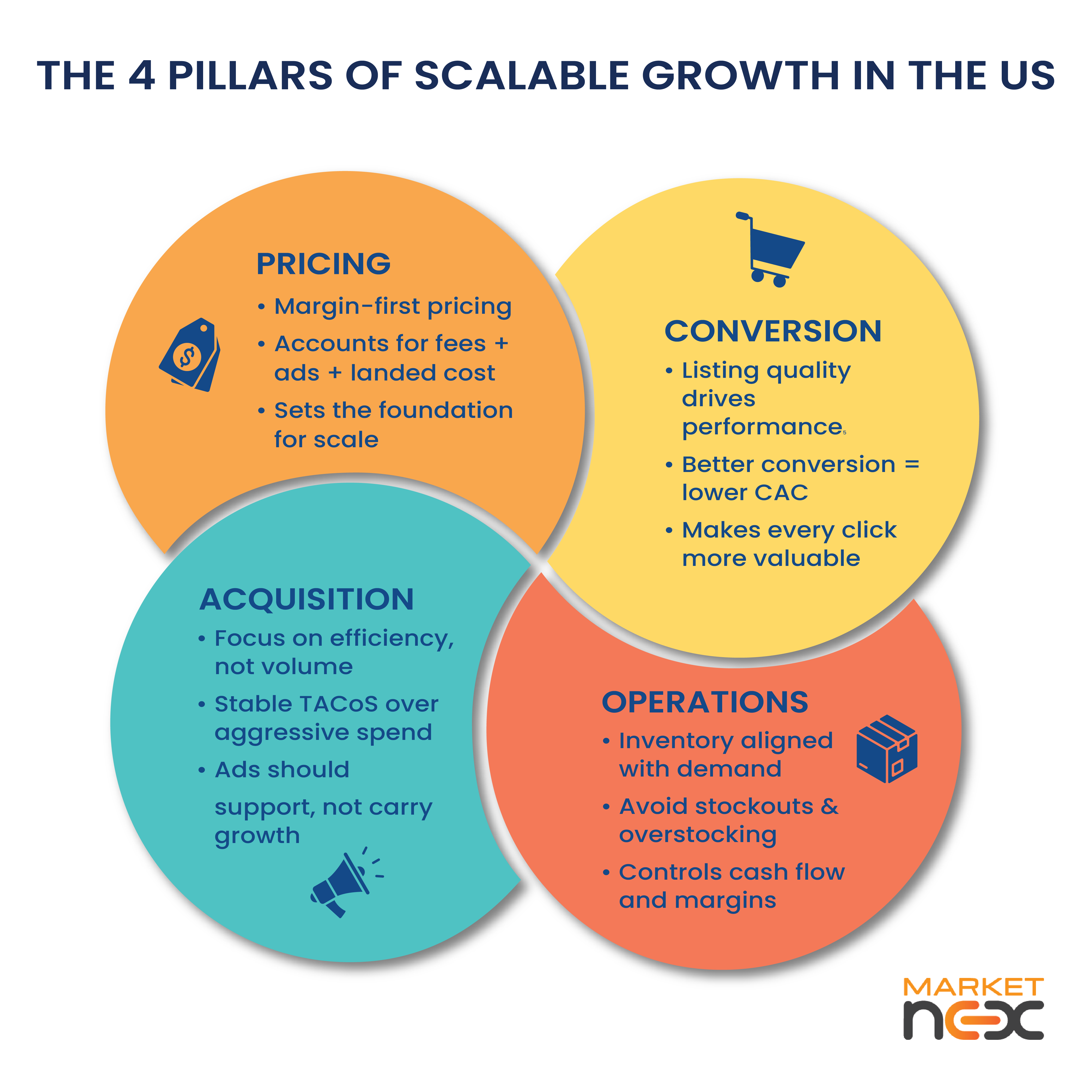
The first is pricing with margin in mind.
Before pushing for volume, you need to know exactly what your product can afford to spend and still remain profitable. That means accounting for Amazon fees, landed cost, and realistic advertising spend, not ideal scenarios. A strong starting point here gives you room to test, optimise, and scale without constantly correcting your price later.
Once pricing is set correctly, the next lever is conversion.
In the US, traffic is accessible. What separates products is how well they convert that traffic. This is where listing quality, positioning, and reviews start doing the heavy lifting. A well-optimised listing doesn’t just improve sales, it reduces your dependency on ads by making every click more valuable.
With conversion in place, acquisition becomes more efficient.
Instead of aggressively increasing ad budgets, the focus shifts to maintaining a sustainable cost of acquisition. As conversion improves, your effective CAC drops, and ads start working with your margins rather than against them. This is where most of the early efficiency gains come from.
The final piece is operational stability.
Inventory and logistics need to support the momentum you’re building. Stockouts can reset ranking and increase acquisition costs, while overstocking locks up capital and slows you down. The goal is to stay in control, ensuring that supply, demand, and cash flow move in sync.
How to Know If You’re Scaling Too Early
Early traction in the US can be misleading. Sales pick up, ads start converting and revenue moves faster than it typically does in India. On the surface, it looks like the product has found its place in the market. But that early momentum doesn’t always mean the system underneath is ready to scale.
The easiest way to spot this is through consistency.
If your numbers don’t behave within a predictable range, you’re not ready to scale yet.
TACoS might look acceptable on average, but if it swings between 14% and 22% week to week, it’s not stable. Conversion may look decent in isolation, but if it moves between 9- 14% depending on traffic quality, your acquisition cost will remain inconsistent. These signals suggest the system is still unstable.
The same applies to inventory and operations.
If you’re frequently switching to faster, more expensive shipping to avoid stockouts, or over-ordering to “stay safe,” your cost structure is still reactive. At scale, that directly impacts margins and cash flow.
What you’re looking for instead is control.
Stable conversion within a narrow band, acquisition costs that don’t fluctuate unpredictably with spend and inventory cycles that are planned. When these start holding steady, scaling becomes a decision, not a risk.
That’s the difference.
In the US market, growth comes quickly. But sustainable growth only follows once the system behind it is steady enough to handle it.
What stable scaling actually looks like
Let me tell you when scaling in the US actually begins. Not simply when revenue increases but when your numbers become more predictable.
- You know your steady-state CAC
- Your conversion rate is competitive within the category
- Your TACoS operates within a defined, sustainable range
- Your inventory cycles align with demand
At that point, growth stops being reactive. Ads begin to reinforce organic momentum, as stronger conversion lifts rankings and gradually reduces reliance on paid acquisition.
This leads to more stable margins, simply because the underlying systems are working as they should. And that’s when the business starts compounding.
High Sales vs Real Profitability, At a Glance
What makes the US market deceptive is how strong it looks from the outside.
What Separates Scalable Businesses from the Rest According to MarketNex
What determines how far you scale is how well your numbers hold as volume increases.
This is a pattern we consistently see across brands working with MarketNex. Revenue alone stops being a reliable signal. Two businesses can be doing similar numbers, but operating very differently underneath.
One has clarity on margins, cost structures, and how each lever impacts profitability. The other continues to grow, but without the same visibility into what that growth is actually producing.
That gap doesn’t show up immediately but, over time, it compounds.
Because at scale, growth is not just about how much you sell. It’s whether the business is being managed as a set of tactics, or as an economic system.
The Real Takeaway
Entering the US market is no longer the barrier it once was. With the right product and a functional setup, most brands can generate demand.
What’s far more difficult is holding that growth once it starts.
The US doesn’t give you the luxury of figuring things out slowly. It reflects the strength of your unit economics almost immediately. If your structure is sound, growth compounds. If it isn’t, increasing sales start putting pressure on pricing, acquisition, and margins just as quickly.
That’s the real shift between India and the US.
In India, the challenge is getting the product to sell. In the US, the challenge begins after it does.
And that’s what ultimately defines the outcome.
Not whether you can grow, but whether your business is built to scale that growth with control, consistency, and clear economics behind it.
FAQs
1. How much capital do you realistically need to start selling on Amazon USA from India?
There isn’t a fixed number but most brands underestimate the working capital required. Beyond initial inventory, you need a buffer for freight, Amazon fees, and at least 2- 3 months of advertising spend before efficiency stabilises. For most categories, a starting range of ₹6.5L- ₹16L ($8,000- $20,000) is considered a practical minimum to avoid constant cash flow pressure.
2. What kind of products from India work best in the US market?
Products that are lightweight, easy to ship, and have strong perceived value tend to perform better. Categories like home, kitchen, textiles, and certain wellness products do well because they allow for better pricing and branding. Highly commoditised or bulky products are harder to scale profitably.
3. How long does it take to stabilise sales and profitability in the US?
Most brands take a few months to stabilise. The early phase is spent understanding conversion rates, ad costs, and customer behaviour. Profitability usually improves once these numbers become predictable and less volatile.
4. Is FBA necessary for selling on Amazon USA from India?
FBA is not mandatory, but it is the most commonly used model because it improves delivery speed and conversion rates. Most brands start with FBA and then optimise how they use it over time to manage costs more efficiently.


